Films
About films or film making.
HDR video with SLRs
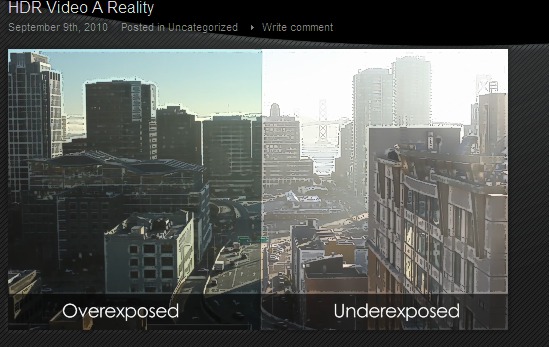
HDR is kind of cool – a nice way to get past the limitations of solid-state image sensors and recover some of the latitude of film, even improving on it.
The problem is that solid state image sensors tend to have very linear responses to light – an underexposed image vanishes into the noise floor of the sensor while an overexposed image clips off to pure white. Film exposure response is commonly called an “s-curve” and basically means there’s some data in the random conversion of a light sensitive molecule here or there even in the most underexposed image, and a few that resist converting under the harshest blast of light such that there is perceivable data in both.
This film is a pretty impressive example of HDR video. But there’s something a bit odd about such a technical achievement in cinematography mixing up “underexposed” and “overexposed.” The funny thing is, they’re using the terms as in making a print (e.g. printing on photo paper) or an x-ray where more light darkens the print: the paper starts out white and turns black with more light vs. a film or digital exposure where the media yields a black result that increases in representational lightness with with increasing light exposure.
Chico and Rita
TFF 37 Mini Review: Chico and Rita, Spain-Cuba, 2010, 96m
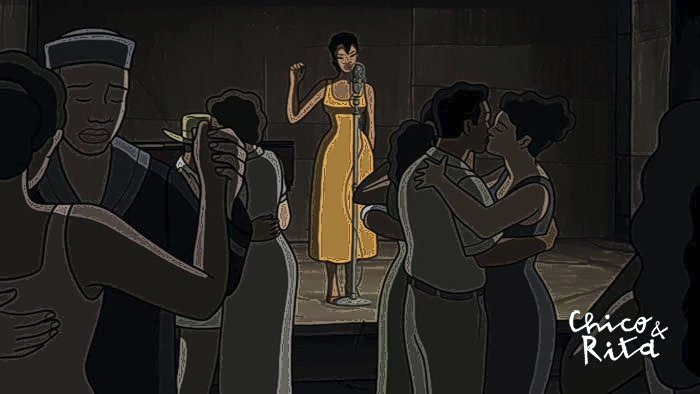
Chico and Rita is an animated story of a talented Cuban jazz pianist named Chico and the love of his life, the talented singer Rita. They chase each other across the Americas and across the decades, overcoming personal and political barriers to their marital bliss. The director went to significant effort to stylistically match the period in geography, dress, and music. The movie’s soundtrack is filled out by performers such as Dizzy Gillespie and Charlie Parker.
Jennifer’s Body
We saw Jennifer’s Body at TIFF09. It is a fun fright fest, I mean how can you go wrong with a super hot high school girl turned human-flesh eating demon who seduces boys and then rips them to shreds. Plus, as a bonus, there is the hottest lesbian kiss in mainstream media between Megan Fox and Amanda Seyfried.
Alas, while Jennifer’s body (the physical corpus) is very much worth of the general public’s lust, there’s no gratuitous nudity, not even a single breast, despite many opportunities. There’s a single distant shot of Fox swimming naked across a lake, but otherwise more about the blood than the boobies.
In the end, the omission of fleeting nudity is forgivable as the two stars more than make up for it with a light-hearted and funny screen presence and some very sexy moments. It was an entirely enjoyable experience. And it was nice to see Ash.
Das weiße Band

I saw The White Ribbon at the Telluride Film Festival. It’s a well crafted film about some very problematic children in Germany just before the first world war.
The movie is intended to in some way illuminate a fertile ground that permits fascism to later grow. While I found the characters interesting and the cinematography particularly beautiful in some scenes, I did not find anything in the story that seemed to suggest that these people were atypically prepared to turn fascist.
The premise seems to be that the children have committed some particularly brutal and random crimes (stringing a wire in the path of a horse and breaking the shoulder of the rider, tying another child up and caning him, tying yet another up and possibly blinding him) and that these “punishments” were “visited” on the children of sinners (except the first, visited on the sinner himself or perhaps on his horse), as justified in a letter left with the last.
That children would commit atrocious acts of brutality is hardly unique and certainly insufficient as an explanation for the rise of the Nazi party. Further, the parent’s “sins” are not particularly shocking, though the doctor isn’t overwhelmingly sympathetic despite having a particularly funny sex scene.
It is a well-constructed character study, if a bit slow; a story of some complex and dramatic events, if lacking a strong conclusion; but not for me a revelatory view of the foundations of fascism.
Red Riding 1974, 1980, 1983
I saw Red Riding at the Telluride Film Festival. It is a three part story of a corrupt police force in Yorkshire over three different eras, each marked by murders. As the series goes on, the weight of the unsolved crimes accumulates until it reaches a breaking point in the third, 1983.
Each movie was done by a different director, and the first, 1974, was the best. It had the strongest story line and the best acting. Andrew Garfield as a reporter was particularly good. 1980, about the yorkshire ripper, seemed to stand somewhat apart from the trilogy, though it did advance certain aspects of the story of police corruption. The last, 1983, brought the trilogy to a satisfying conclusion and was certainly a powerful bit of storytelling, but I found it somewhat burdened by flashback references to the earlier movies that proved a little confusing given the complex story line.
The series was well received at Telluride and many people thought it was one of the best in the festival. I enjoyed it very much, though I was glad I watched the whole series through in one sitting.
Good Hair, Great Documentary
Good Hair (2009)
Chris Rock’s excellent documentary about black hair
Chris Rock explores the astonishing market for hair products in the black community. His interview with Maya Angelou stands out as excellent and charming. Chris traces the market from the hair salons of Harlem and Hollywood to the tonsure ceremonies of India. Along the way we meet the contestants in the annual Hair Battle at the Bronner Brothers’ annual convention.
What the Beep?
The movie What the bleep do we know is a pseudo-scientific exploration of using quantum mechanics to justify a human potential-like pseudo-religious concept. I have an undergraduate degree in physics from MIT, and so I recognized a lot of the arguments as absurd immediately, but I reached the limits of my depth, particularly on the history of QM in this argument. Most, but not all of the concepts could be easily refuted from an undergraduate understanding such as mine, some seem to require more depth. But the practicing physicists I reviewed my answers with seemed to think they had nothing useful to add to the discussion, in part I suspect out of the still-somewhat-in-vogue idea that the best way to confront anti-scientific ideas is to ignore them, viz the debate over intelligent design (which I think, personally, the flying spaghetti monster settled.)
The Last Command (& Alloy Orchestra)
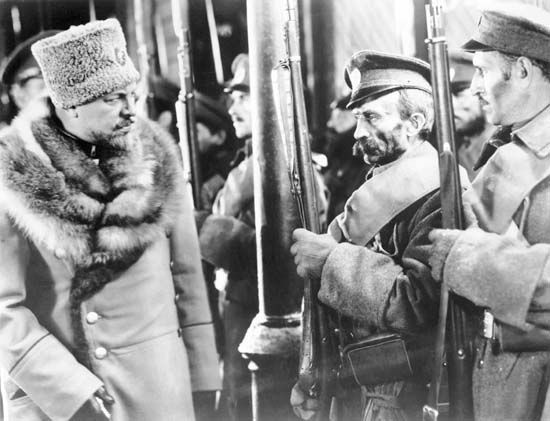
The Last Command is the 1928 silent movie staring Emil Jannings as the Grand Duke of the Tsar’s army and tells the story of his last battle, his capture, escape, and eventual demise in Hollywood as an extra in a film close to his own life.
It is the best silent movie I’ve seen – I genuinely enjoyed it, and I rarely connect to older films, let alone silent ones.
Part of the magic was the performance of the Alloy Orchestra – they are really exceptional and it was a treat to hear their score.
A Pervert’s Guide To Cinema
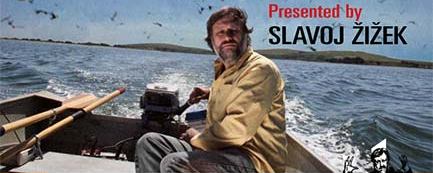
A Pervert’s Guide to Cinema is not as promising as the title would suggest. It is a wonderful collection of clips of various movies that are far more effectively tied to together cinematically than they are philosophically. Slavoj Zizek narrates a discussion of his apparent discomfort with sex, shame at being male, and hatred of his parents as if they were universal neurosis somehow illuminated by cinema. I found his critiques and comments on the films and directors generally interesting and compelling. His generalizations about the motivations for sex, arousal, libido, etc were pretty silly. Comparing the marx brothers to the Id, the Ego, and the Superego… hmm… I found Bataille’s Erotism: Death And Sensuality better thought out, if equally inapplicable to people not plagued with some serious issues.
(Friday, Aug 29 2008 Telluride Film Festival)
Tulpan

Tulpan is about a young naval officer who joins his sister’s family on the steppe’s of Kazakhstan to start his life as a shepherd and fulfill his dreams of living under the stars in a yurt with 900 channels of satellite TV.
He seeks the hand of the mysterious and unseen eponymous “Tulip” the only marriageable woman on the steppe for 500 miles, and either she finds his ears too large (though they are less prominent than Prince Charles’) or her mom is blocking the proceedings. Either way, he is thwarted in his dream and is driven to consider leaving the steppe for the city with his regge loving tractor driving friend who delivers water and essentials to shepherds.
Along the way we witness the birth of a sheep, a protective camel, and a pretty amusing collection of pretty amazing animal moments. It’s funny and cute but perhaps not as engaging as the Cannes prize would suggest.
Glago’s Guest (short) Tulpan was preceded by Glago’s Guest, a Disney short about the minder of Station 7 who’s uneventful days fill piles of logs until one day a something very unusual visits in an act of charity.
Friday, Aug 29 2008 Telluride Film Festival