Films
About films or film making.
Kitty Poop (1995)
Many years ago (21 years, 9 months as of this post), I used some as-of-then only slightly out of date equipment to record a one week time lapse of the cats’ litter box.
I found the video on a CD-ROM (remember those?) and thought I’d see if it was still usable. It wasn’t – Quicktime had abandoned support for most of the 1990’s era codecs, and as it was pre-internet, there just wasn’t any support any more. I had to fire up my old Mac 9500, which booted just fine after years of sitting, even if most of the rubber feet on the peripherals had long since turned to goo. The OS9 version of QT let me resave as uncompressed, which of course was way too big for the massive dual 9GB drives in that machine. Youtube would eat the uncompressed format and this critical archival record is preserved for a little longer.
Time lapse of the litter box. Shot in Sept, 1995 in San Francisco, CA. Captured with a RasterOps ColorBoard 364 Nubus card from a Sony XC-999 on a Mac IIfx.
Futurama is Awesome
I learned two things about Futurama recently which added to my already deep appreciation for the show. The first is that the theme song came from a very cool song by Pierre Henry called Psyche Rock from 1967, which is on youtube. It was remixed by Fatboy Slim in an appealing way.
But what was most interesting recently was to see episode 10 of season 6, the Prisoner of Benda, a spoof of the Prisoner of Zelda but including what may be the first tv-episode publication of the proof of a relatively complex mathematical theorem in group theory as a core plot element.
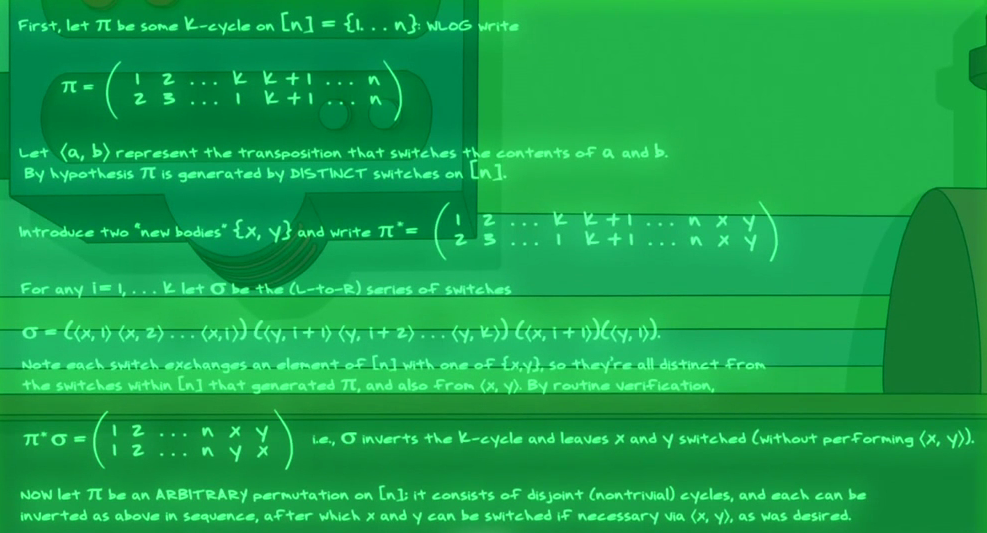
The problem in the plot is that the Professor’s mind swapping machine creates an immune response which prevents swapping back in one step. So how do you get everyone back to into their original bodies? Well, as Sweet Clyde says, it takes at most two extra players [who haven’t swapped yet]. As the entire cast, including the robo-bucket, have swapped bodies, the situation is pretty complex, but fortunately one of the show’s writers, Ken Keeler, has a PhD in applied mathematics from Harvard and found a proof, which is actually shown in the show (above), and then worked in a fast montage that restores everyone.
In the following table, the heading shows the character name of the body, row 0 shows the occupant of that body by the end of the plot’s permutations and before the globetrotters start the transformations. Rows 1-7 show the steps to restore everyone to their original bodies. Each transformation was animated as a pair using the two “extra players” except the last rotation to restore Sweet Clyde and the Bucket.
The SOPA/PIPA Fight is Not Over
Megaupload, the company that enables easy file transfer used by 50,000,000 people every day, was sized by the DOJ. Check www.megaupload.com
This is an illegal, unconstitutional seizure. It is an example of the scum who run entertainment companies like Universal (who illegally got MegaUpload’s video yanked from youtube by filing a false DMCA takedown) turning US law enforcement and the US judicial system into criminal enforcers to create a business model around theft and intimidation to replace their obsolete and irrelevant role as gate keepers and toll collectors between artists and their audiences.
If SOPA/PIPA pass, links to the sized domain would have to be expunged from any site even talking about them. This is intolerable. It is a subversion of democracy and outright theft of the public domain by those who would retard or even reverse progress to protect their profits and wealth.
The constitution grants the privilege of a temporary copyright to artists and inventors as a mechanism to promote the progress of science and the useful arts. Laws that extend this privilege in a manner that fails to promote the progress of science and the useful arts are plainly unconstitutional. Record companies have no natural right to stop you from using your hardware, your devices, to rearrange the bits on your systems in any way you like. They have turned the discussion to claim they have a property right to your data through manipulation and outright lies. The only fair response to their illegal and heinous acts is to revoke their privilege and drive them swiftly into bankruptcy so they no longer have the resources to bribe our representatives into ignoring the constitution.
The DOJ should be using RICO to shut down entertainment companies that use intimidation to protect profits, not innovative companies acting to expand the public domain in a manner clearly consistent with the goals of the framers of the constitution.
[youtube]http://www.youtube.com/watch?v=K9caPFPQUNs[/youtube]
TFF38D2F4 The Kid With A Bike
The Kid With A Bike is a film by the Dardenne brothers, who brought “The Child” to the Telluride Film Festival a few years back. There is a strong family resemblance between the films: durable but trouble prone protagonists in gritty, lower class struggles where their every step forward seems to result in a step back and who’s troubles are mostly self-inflicted, and yet sympathetic and identifiable responses to difficult circumstances.
Thomas Doret plays a little boy named Cyril who’s proof to all external harm, but victim to the internal consequences of being abandoned by his father. He is adopted by an attractive and indomitable hair dresser played by Cecile de France who has an affinity for Cyril that seems driven by something strong, but offscreen.
The story moves Cyril from victim to victimizer and finally to redemption in a way that is satisfying and compelling.
TFF D1F3: Albert Nobbs
Albert Nobbs is an great film. See it.
It is the story of a curious butler in 1890s Dublin who suffered a difficult childhood and to survive took a job as a waiter, and the worked his way up to being a butler in a small but swanky hotel. The thing is, he’s a woman played by Glenn Close.
His carefully controlled life is turned upside down when he has to share his room with a painter working on the hotel and his view of the world and of his own future changes dramatically.

Glenn Close introduced the film an described it as a labor of love that she has spent 15 years working on. Her acting is superb and the story is very funny when it tries to be and truly touching without being cloy or saccharine. While Glenn’s performance stands out, none of the cast come up short and Janet McTeer is also particularly strong.
TFF 38 D1F2: Pina
Pina is Wim Wenders tribute to Pina Bausch in 3D. I’m not a big dance fan, not even ballet let alone modern dance, but this was a very beautiful film and I enjoyed it. Wim Wenders introduced the film and told the audience how he had met Pina 20 or more years before starting production and had wanted to make a film about her. For all of those 20 years every time they crossed paths she asked if he was ready to make his film and he said he didn’t know how, but was learning.
Wenders said he was quite taken by 3D, specifically U2 3D which he thought was a great name, but more so that the 3D technology used was sufficient to capture the essence of Pina’s dance, and so he began production, but just before production was to commence, Pina passed away.
The dancers in her troupe convinced him that he should make the film, that it is what she would have wanted, and so the film is both an beautifully shot document of Pina’s dance troupe and a tribute to Pina.
I’ve been involved with 3D film for a long time (going back 16 years I built a stereo rig from a pair of Arriflex cameras for Michael Naimark’s Be Here Now). This was the first time I got to see Dolby’s double-tristmus 3D . The way it works is each projector projects an approximately RGB signal, but with the exact wavelengths of RG&B shifted between them (and not shared). The passive glasses pass only the correct eye’s 3 color wavelengths and reject the rest. Looking through them, one is slightly magenta shifted and one slightly cyan shifted, but you quickly compensate for the slight color error, especially since one eye errs one direction and the other the opposite. If you look through both a left eye and a right eye filter (say by borrowing your neighbors pair and putting them over yours upside down), almost no light passes.
The 3D quality of the movie is quite good, better than shutter glasses with less peripheral annoyance. Only very bright highlights (like the glint of lights in a dancer’s eye) exhibited odd stereo artifacts. It is commonly noted that the focal accommodation and parallax accommodation of a stereoscopic projection is very wrong–your eyes focus on the same plane (the screen) no matter what the image displacement is, so your mind gets two conflicting data inputs – one saying “I see 3D” and the other saying “I’m focusing on a plane” and the result is eye strain and often headaches, and this technology is no different. It definitely caused some eye strain to watch it, but the effect was good and overall I’d say worth it.
TFF 38 D1F1: The Turin Horse
First day of films at TFF began with The Turin Horse, a slow, atmospheric, challenging, inaccessible film by Bela Tarr about what happened to the owner of the horse who’s beating drove Nietzche mad.

It is a long film, entirely in black and white, with very little dialog. It is visually quite striking, but definitely not going to make it to the cineplex. The story grows perhaps allegorical or possibly apocalyptic, but maybe reverses the story of creation. Maybe not. But things definitely go from bad to worse to cosmically bad.
eat pray love
I get the Julia Roberts is a hot chick, even at her current age, but why… why are they showing Eat Pray Love on the airplane? She’s pretty enough, but the “eat” part is disgusting. Close ups of people eating is a standard trope for illustrating how revolting the super villain is, not a mechanism to make the pretty people seem sensual.
OK, maybe an ice cube is sensual, but stuffing pizza in a huge mouth on screen is just gross. No wonder the movie failed; without sound, this whole movie is Julia Roberts stuffing her gigantic mouth.
Films at TFF 37
I saw the following films at the Telluride Film Festival. I’ll try to get around to adding a few notes on each:
- Chico and Rita
- Oka! Amerikee
- The Illusionist
- Moana: A Story of the South Seas
- The First Movie
- Precious Life
- Incendies
- Inside Job
- Tabloid
- Happy People: A Year in the Taiga
- The Way Back
- Le Quattro Volte
- Tamara Drewe
- Never Let me Go
- Biutiful
- Of Gods and Men
- Black Swan
The film festival was excellent, as always. The films selected are rarely anything less than excellent, so reviews tend to range from good to superlative. It is probably the best film festival to attend for people who really love films. While the environment is low-key and friendly, the festival is attended by luminaries of the film industry and most films are introduced by the directors. Technically the festival is flawless and some of the venues are fitted with top of the line projection and sound equipment.