A week of tweets: 2009-09-27
- Just had an excellent dinner at roosevelt tamale #
- LA flight leaves from mysterious and remote “G92” at SFO. DOH! Next time I will use international RCC. #
- near 34.10586, -118.341658 http://tinyurl.com/y8h4znp dinner at yamashiro. Yum! #
- Pleasant, productive stay in LA, back home for a day or two. #
- near 37.7714, -122.423816 http://tinyurl.com/ydkoek4 Waiting for It’s Tops to open with @phragments http://twitpic.com/jb7bt #
- Very sad, no It’s Tops: Bruce didn’t make it to work. Hope he is OK. #
Powered by Twitter Tools
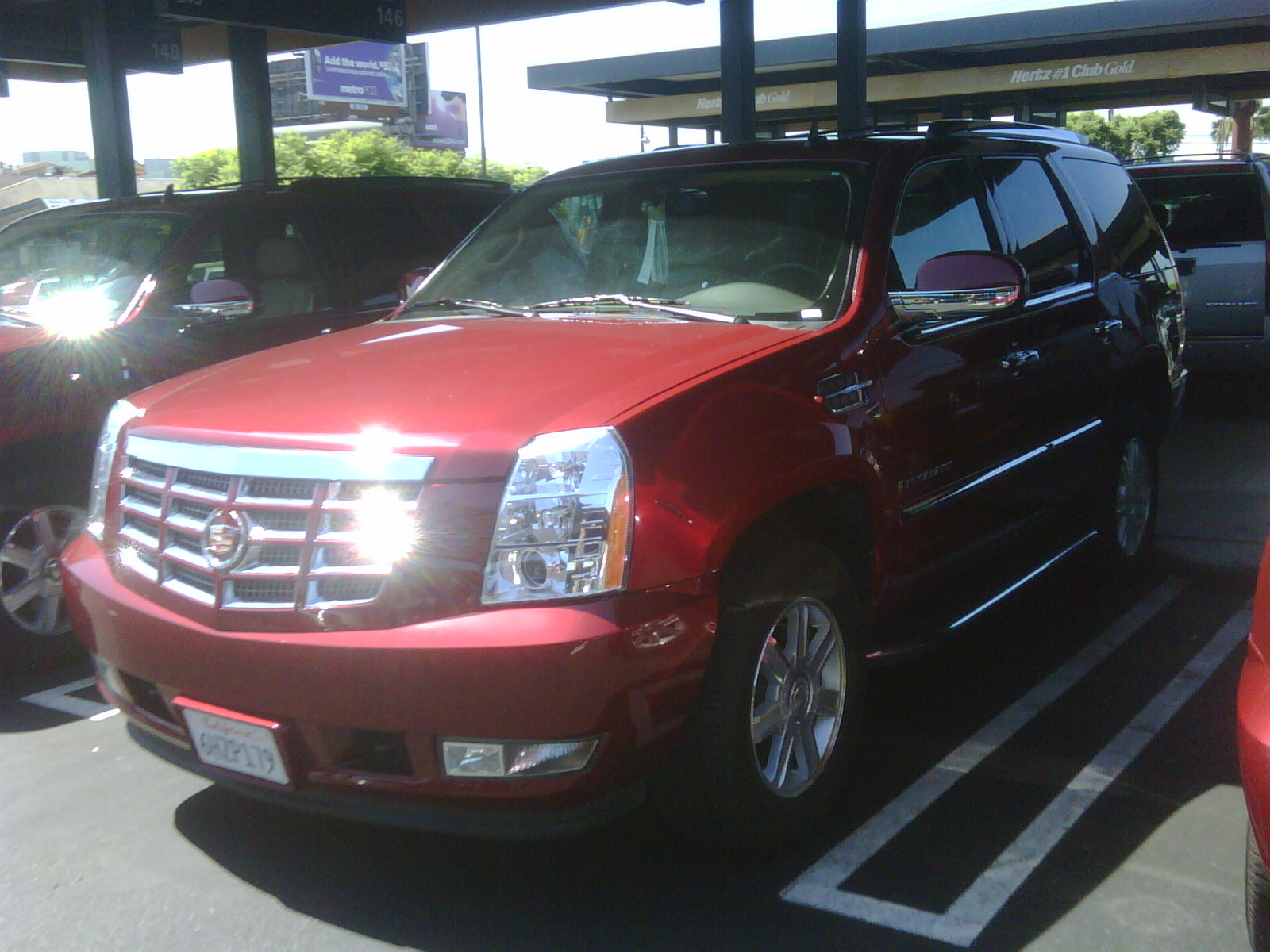
Cadillac Escalade
It is nice Hz upgrades my rental, but this is just stupid.
A week of tweets: 2009-09-20
- near 43.641324, -79.374603 http://tinyurl.com/ojpefm brunch at Toula’ with @phragments http://twitpic.com/hm52v #
- #TIFF The Loved Ones: holy shit amazing “then you’ve got Lola, who’s hot pink and super fucked up” -Victoria Thane http://twitpic.com/horr8 #
- #TIFF Bitch Slap: beautiful, well endowed, strong women killing men and fighting each other by Zoe Bell. Excellent. http://twitpic.com/hswcq #
- #TIFF Google Baby: not so much about Google… A documentary about baby outsourcing: Israeli sperm, US embryos, and Indian Uteri. #
- #TIFF La Pivellina: sweet circus folk find an adorable child and while circmstances are difficult, everyone falls in love. #
- Whip It best of #TIFF. Laugh, cry. Take a little girl, your own or one off the street. It rocks. Drew wins. Go Zoe Bell! Yay Julliet Lewis! #
- #TIFF Hipsters: Really fun, dynamic film about hipster rebels in 1950’s Moscow. Great music. Evgeniya Khirivskaya is gorgeous. #
- near 43.66602, -79.383919 http://tinyurl.com/lf9e3y Bar Volo: best draft selection in T.O. http://www.barvolo.com/ #
- As @phragments said, jeebus freaks made lunch hell. http://twitpic.com/ickmj #
- YYZ to SFO, thinking about finishing up two weeks of festival movies by going to the 10:20 District 9 show at the metrion, then It’s Tops. #
Powered by Twitter Tools
A week of tweets: 2009-09-13
- Flying SFO-JFK this evening; ual ps flights are as good as domestic gets. But tomorrow’s flight promises to be more pleasant still. #
- On board raspberry mojito? Not bad… #
- near 38.49813, -107.89756 http://tinyurl.com/mw5jnm made it http://twitpic.com/gcthv #
- At TIFF. http://twitpic.com/ggd13 #
- Yesterday I saw Red Riding: 1974, 1980, 1983 all in a row. Intense and convoluted. It would have been hard to follow too far apartm #
- Yesterday I saw Haneke’s The White Ribbon. Children of the corn without an ending in german and b+w. Funny sex scene though. #
- Just saw Solondz’ sequel to Happiness, Life During Wartime. Very funny and clever back references. Some lines lost to loud laughter. #
- #TFF wear a parka if you’re going to the Galaxy theater. #
- The Miscreants of Taliwood: rather intense, unique view of Pakistan, bit of a rough edit and revolves around Gittoes, but fascinating. #
- RT @seanpercival so @shitmydadsays got a book deal, first book deal based on a Twitter account I believe. #
- #TFF just saw A Profit, excellent prison movie. Lots of languages, French locations. Gripping. Oz in French. #
- Saw Farewell, reminiscent of The Lives of Others, about the Soviet and French spies that won the cold war. Excellent. #
- #TFF saw Room and a Half, a fanciful meditation on Brodsky and dying parents and going home. #
- #TFF saw Fish Tank, slow meditation on bad judgment and profane children. The little girls non-stop obscenity stole the show. #
- #TFF saw a collection of Russian shorts by Khrzhanovsky. Very taken by Kozyavin and The King’s Sandwich. #
- #TFF saw Vincere, the story of Mussolini’s other wife and their son. Good, solid story and well acted. Best subtitles of the show. Excellent #
- #TFF saw Herzog’s My Son, My Son. Written in 5 days, made in 5 weeks. Overshadowed by the PSA short The Plastic Bag; Herzog voiced the bag. #
- #TFF just saw Gigante: very sweet movie about a huge metal head security guard and the cleaning woman of his dreams. Funny. From Uruguay. #
- #TFF just saw Paranormal Activity. Scary, fun. Excellent first feature and amazing work for $11,000. Oren Pell is one to watch. #
- #TFF just saw Disco and Atomic War: the cold war was REALLY won by a Finn broadcast of Emmanuelle into Estonia. Yay pr0n! Excellent docu. #
- #TFF saw El Verdugo (1963) hilarious spanish black comedy about an executioner and a mortician in fascist spain. See it if you can. #
- near 43.640843, -79.375792 http://tinyurl.com/qacntj oh canada. At TIFF09, staying on the harbor. http://twitpic.com/h85rs #
- near 43.649278, -79.391446 http://tinyurl.com/nf4rf3 visit active surplus in toronto #
- #TIFF just saw Jennifer’s Body. Fun, funny, entertainingly scary. Hottest lesbian kiss in mainstram cinema. Thanks for tix, Dubiecki. #
- #TIFF just saw Jennifer’s Body. Fun, funny, entertainingly scary. Hottest lesbian kiss in mainstram cinema. Thanks for tix, Dubiecki. #
- Getting coffee at the world trade centre (T.O.) #
- #TIFF Kelin, Khazak for Daughter in Law, a gorgeous, dialogless film about competition for the hand of a lovely woman in the Altay mountains #
- #TIFF Vision: the life of Hildegard of Bingen starts slowly but grows more powerful, especially warming to her love of Richardis. Excellent. #
- Eating dinner at Hooters Toronto with Carolyn. Her idea. Delightfully tacky? #
- #TIFF L’Enfer de Henri-Georges Clouzot. Fascinating story of the making of, Lost in La Mancha but too many talking heads, too little footage #
- #TIFF Slovenian Girl she tries to float a mortgage on prostitutuion but gets more then she anticipated. Funny and well done if a bit slow #
- #TIFF Dogtooth, hungarian phrasebook childrearing. Funny premise, sex, & clever ideas made tedious by poor execution, lack of flow, stilted #
- #TIFF Io, Don Giovanni: expelled from Venice, libertine da Ponte, becomes librettist to Mozart and finds salvation in Vienna. Excellent. #
- near 43.649201, -79.373509 http://tinyurl.com/qdoh34b C’est What: great selection of beer, kitchen oen until 2:00 http://twitpic.com/hk4t4 #
Powered by Twitter Tools
Jennifer’s Body
We saw Jennifer’s Body at TIFF09. It is a fun fright fest, I mean how can you go wrong with a super hot high school girl turned human-flesh eating demon who seduces boys and then rips them to shreds. Plus, as a bonus, there is the hottest lesbian kiss in mainstream media between Megan Fox and Amanda Seyfried.
Alas, while Jennifer’s body (the physical corpus) is very much worth of the general public’s lust, there’s no gratuitous nudity, not even a single breast, despite many opportunities. There’s a single distant shot of Fox swimming naked across a lake, but otherwise more about the blood than the boobies.
In the end, the omission of fleeting nudity is forgivable as the two stars more than make up for it with a light-hearted and funny screen presence and some very sexy moments. It was an entirely enjoyable experience. And it was nice to see Ash.
Das weiße Band

I saw The White Ribbon at the Telluride Film Festival. It’s a well crafted film about some very problematic children in Germany just before the first world war.
The movie is intended to in some way illuminate a fertile ground that permits fascism to later grow. While I found the characters interesting and the cinematography particularly beautiful in some scenes, I did not find anything in the story that seemed to suggest that these people were atypically prepared to turn fascist.
The premise seems to be that the children have committed some particularly brutal and random crimes (stringing a wire in the path of a horse and breaking the shoulder of the rider, tying another child up and caning him, tying yet another up and possibly blinding him) and that these “punishments” were “visited” on the children of sinners (except the first, visited on the sinner himself or perhaps on his horse), as justified in a letter left with the last.
That children would commit atrocious acts of brutality is hardly unique and certainly insufficient as an explanation for the rise of the Nazi party. Further, the parent’s “sins” are not particularly shocking, though the doctor isn’t overwhelmingly sympathetic despite having a particularly funny sex scene.
It is a well-constructed character study, if a bit slow; a story of some complex and dramatic events, if lacking a strong conclusion; but not for me a revelatory view of the foundations of fascism.